
How Can You Choose Space-Saving Furniture for a Small Home?
Space-saving furniture should reduce the floor area or storage burden created by daily activities without making those activities inconvenient. The most useful pieces combine functions, use vertical space, fit exact room dimensions, and remain easy to open, assemble, clean, and move.
Small-home furniture selection starts with measuring how people move through the room. A compact product that blocks a doorway or requires excessive clearance is not truly space-efficient.
Table of Contents
- Map the Room Before Shopping
- Choose Furniture That Performs More Than One Job
- Use Vertical Space Carefully
- Prefer the Right Storage Type
- Look for Transformable Features You Will Actually Use
- Match Furniture Scale to the Room
- Check the Product Beyond Its External Dimensions
- Factory Support for Compact Furniture Collections
- A Practical Final Checklist
Map the Room Before Shopping
Create a simple floor plan and record:
Wall-to-wall dimensions
Ceiling height
Door and window swing
Hallway and entrance width
Electrical outlet locations
Radiators, vents, and baseboards
Permanent architectural obstacles
Main walking routes
Measure the route from the building entrance to the final room as well. Flat-pack furniture can help because panels are transported before assembly, but the completed piece must still fit its intended location.
Use removable tape to outline furniture on the floor. This provides a more realistic sense of circulation than looking only at dimensions on a screen.
Choose Furniture That Performs More Than One Job
Multifunctional furniture reduces the number of separate products a room requires. Useful examples include:
TV Stands with Drawers
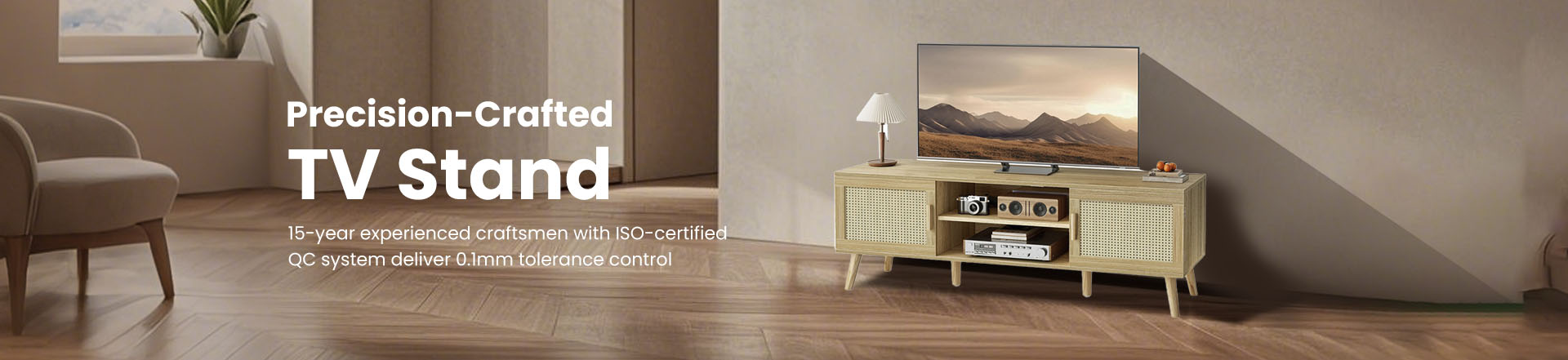
A low TV cabinet can store media equipment, documents, games, or household items. A model with a balanced combination of open and closed storage can replace a separate media shelf and small cabinet.
Computer Desks with Shelves
A desk with a bookshelf, monitor riser, file drawer, or tower compartment uses the workstation footprint more efficiently. Corner desks are particularly useful when an otherwise underused corner can accommodate the full depth of the product.
Nightstands with Charging and Storage
A nightstand can combine drawers, open storage, lighting, and charging access. DAKSHOME’s multifunctional RGB LED bedside tables illustrate how several bedside functions can be integrated into one compact unit.
Storage Beds and Headboards
Beds occupy substantial floor area, so under-bed drawers or a storage headboard can recover space that would otherwise be unused. Ensure the drawers have enough opening clearance and remain accessible after other furniture is installed.
Use Vertical Space Carefully
Tall bookcases, wardrobes, kitchen shelves, and over-toilet storage units can increase capacity without taking up much additional floor area.
Vertical furniture should not simply be tall; its shelves must also be usable. Frequently needed items belong between comforTable waist and shoulder height. Less-used items can occupy upper sections, while heavier items should generally remain lower.
Tall or narrow furniture may require anti-tip restraint. Follow the product instructions and use fixings appropriate for the wall construction. Renters should discuss anchoring requirements with the property owner instead of ignoring a safety provision.
Prefer the Right Storage Type
Open shelves make a room feel accessible and keep frequently used objects visible. Too many exposed items, however, can create visual clutter.
Closed cabinets provide a calmer appearance but require door clearance. Sliding doors may save circulation space, while drawers provide full access to stored items but need enough space in front to extend.
Before selecting a cabinet, list the objects it will hold. Shelf height, drawer depth, and internal width matter more than the advertised number of compartments.
Look for Transformable Features You Will Actually Use
Folding desks, extendable tables, nesting tables, and convertible beds can be highly effective, but only when changing their configuration is simple enough for daily life.
Test or evaluate:
Number of steps needed for conversion
Weight of moving components
Required clearance
Locking stability
Finger-pinch points
Hardware durability
Accessibility when another item is in use
A complex convertible product may remain permanently open, eliminating the space-saving benefit. Simpler multifunctional storage is sometimes more useful than a highly transformable mechanism.
Match Furniture Scale to the Room
Small furniture is not always efficient. Several tiny storage units may consume more floor space and create more gaps than one properly sized vertical cabinet.
Choose proportions that support the room:
Low TV stands can preserve open wall space
Narrow bookcases use small wall sections
L-shaped desks can occupy corners
Shallow cabinets help maintain walkways
Modular units adapt to changing layouts
Furniture with legs may create a lighter visual effect
Light finishes and open structures can make a room appear less crowded, but visual openness should not replace adequate structural support.
Check the Product Beyond Its External Dimensions
A compact cabinet can still waste internal space through thick partitions, unsuitable shelf spacing, or inaccessible corners. Compare usable capacity rather than exterior size alone.
For desks, check knee clearance and desktop depth. For wardrobes, review hanging height and drawer access. For TV stands, verify cable openings and equipment ventilation. For folding beds, confirm both folded and open dimensions.
Factory Support for Compact Furniture Collections
As a reliable export supplier of space-saving home furniture, DAKSHOME manufactures products for living rooms, home offices, bedrooms, kitchens, dining rooms, and bathrooms. Our range includes TV stands, computer desks, Gaming Tables, bookcases, storage cabinets, nightstands, wardrobes, shelves, bed frames, and other panel-based furniture.
Our factory can review dimensions, panel materials, metal structures, storage layouts, finishes, hardware, logo requirements, assembly instructions, and carton design. OEM and ODM support allows buyers to adapt furniture to apartment markets, e-commerce channels, rental properties, student housing, and other compact environments.
Production control covers raw materials, machining, assembly verification, surface inspection, packing, and loading. For space-saving furniture, dimensional control is especially important because small rooms leave little tolerance for unexpected projections or incorrect door orientation.
A Practical Final Checklist
Before ordering, confirm that the furniture:
Fits the measured location and delivery route
Leaves a comfortable walking path
Provides useful—not merely advertised—storage
Performs at least one necessary daily function
Opens without hitting another object
Supports the intended load
Can be secured safely when required
Uses materials suitable for the room
Can be assembled and maintained conveniently
Does not depend on a feature you are unlikely to use
The best space-saving furniture makes a small home easier to live in, not merely easier to photograph. Accurate measurements, useful storage, appropriate scale, and realistic daily operation are the foundations of a successful compact-room layout.