
How To Build A Bar Cabinet
Below is the exact factory process we follow to make a modern Bar Cabinet with optional wine rack, stemware rails, mesh/solid doors and LED backlighting. The flow is standardized for batch production and can be scaled for custom sizes.
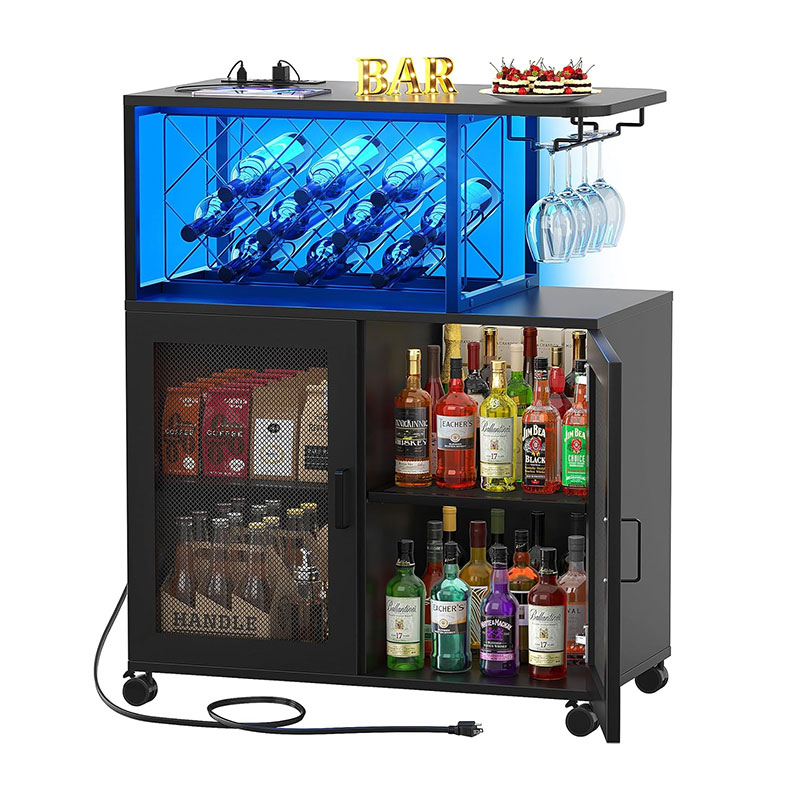
Table of Contents
1) Product Engineering & Pre-Production
1.1 Requirement intake & DFM
Confirm target dimensions, style (modern/industrial/rustic), storage mix (bottle shelves, X-wine rack, closed bay), lighting, casters, and load ratings.
Convert client drawings into manufacturable models; run DFM checks on panel thickness, hinge clearances, cable routing, and anti-tip hardware.
1.2 CAD/CAM & documentation
Build the bar cabinet in 3D CAD (components & assemblies), then auto-generate:
Exploded views with BOM, part IDs, and joinery.
Cut lists and CNC nesting layouts for 1220×2440 mm sheets.
Drill maps (32 mm system) for shelf pins and euro hinges.
Release a Manufacturing Pack: BOM, routing card, work instructions (WI), inspection sheets, color chips, packaging spec.
1.3 Pilot sample
Run a single prototype to verify fit, ergonomics, door reveals (1.5 mm), and lighting brightness. Record any shims or offsets in the WI.
2) Materials & Machining
2.1 Material preparation
Sheet goods: 18 mm cabinet-grade plywood (carcass), 12 mm (shelves/rack), 6–9 mm (back). Solid wood or ABS edge banding 1.8 mm.
Metals: cold-rolled steel for mesh doors/rails; ALU channels for LEDs.
Hardware: soft-close euro hinges, 5 mm shelf pins, leveling feet, pulls, magnetic catches, anti-tip brackets, stemware rails.
Electrical: 12 V LED strip (CRI≥90), UL/CE adapter, rocker/touch switch.
2.2 CNC cutting & labeling
Import nest to CNC. Cut all panels with 0.2 mm kerf compensation.
Automatic part labeling prints QR + part ID + program to keep traceability through finishing and assembly.
2.3 Edge banding
Apply 1.8 mm ABS or solid-wood lipping on all exposed edges.
Glue: PUR for heat/water resistance; edge temperature 190–200 °C; radius scrapers + buffing for seamless edges.
2.4 Routing, drilling & joinery
CNC drill 5 mm system holes (front/back rows) for adjusTable shelves.
Cut dadoes/rabbets for top/bottom and back panel; mill toe-kick.
Create hinge cups (35 mm) and handle pilot holes.
X-wine rack: half-lap slots 6 mm deep on 12 mm panels for tight interlock.
2.5 Metalwork (if required)
Mesh doors/frames laser cut; edges deburred; TIG/spot welds polished.
Powder-coat line: zinc-rich primer + top color; bake at 180 °C / 15 min.
2.6 Sanding & surface prep
Robotic wide-belt sanding (P120→P180) then hand-block critical edges.
Dust extraction to <1 mg/m³; moisture check 8–12% before finishing.
3) Finishing & Sub-Assemblies
3.1 Coating systems
Clear grain finish (wood look): sealer → sand (P320) → topcoat ×2. Water-borne polyurethane, 35–15 gloss according to spec.
Stain + clear: conditioner → wipe stain → sealer → topcoat.
Opaque color: adhesion primer → pigmented topcoat ×2 → matte clear for scratch resistance.
Stone/laminate tops: separate line; stone sealed, laminate bonded to 18 mm substrate with contact adhesive and trimmed.
3.2 Quality gates during finishing
Color ΔE ≤ 1.0 vs. master chip; film thickness 90–130 μm; cross-hatch adhesion 4B–5B.
Edge coverage and orange-peel level scored against AQL samples.
3.3 Sub-assemblies prepared in parallel
Doors: assemble frames, insert mesh/glass, install hinges loosely.
Wine rack module: glue the “X” insert, sand flush.
Stemware rails: pre-drilled and countersunk, screws staged in kits.
LED set: cut to length, solder pigtails, mount in aluminum channels with diffusers; 100% bench-test (polarity, brightness, current draw).
4) Final Assembly, Electrical, QC & Packing
4.1 Carcass assembly
Glue + clamp top/bottom into side dados; add front/back stretchers.
Insert back panel into rabbet; brad-nail 150 mm spacing (acts as squaring member).
Fit dividers; torque pocket screws to 3–4 N·m (no over-drive).
4.2 Module installation
Slide wine-rack module; fasten through hidden cleats.
Install adjustable shelves; verify pin engagement depth (≥8 mm).
Fit stemware rails under top, 90–100 mm apart per channel.
4.3 Electrical integration
Drill 20 mm grommet; route LED leads through channel.
Fix power supply in a ventilated recess with screw bracket and strain relief.
Connect via quick plugs; mount switch (rocker/touch) per spec.
Test: 12 V at load, no visible hot spots, uniform diffusion, adapters at <45 °C after 30-min burn-in.
4.4 Doors, hardware & ergonomics
Hang doors; set hinge cams for 1.5 mm reveals all sides.
Mount pulls at consistent centerlines; add magnetic catches.
Leveling feet adjusted so the top is flat within ±1 mm across 1200 mm.
Install anti-tip bracket and instruction label.
4.5 Functional & durability inspection (AQL 1.0)
Shake & racking test: diagonal force 200 N, no joint separation.
Shelf load: 40 kg static for 1 hr; deflection ≤ 2 mm, no cracks.
Drawer/door cycle (if applicable): 5,000 open/close without misalignment.
Surface: gloss reading within spec; scratch test with HB pencil; stain resistance to citrus/alcohol checked on an off-cut coupon.
4.6 Cleaning & branding
Remove protective films, polish surfaces, apply logo/QR tag that links to the maintenance guide and parts list.
4.7 Packaging
Inside: foam edge protectors, anti-abrasion wrap, hardware kit in separate box, desiccant.
Outer: double-wall carton with drop-test scheme (ISTA 1A).
Palletize with corner posts; straps + stretch wrap; “This Side Up” and center-of-gravity marks.
Optional: flat-pack format with step-by-step pictorial manual.
4.8 Logistics & after-sales kit
Packing list, inspection sheet, spare touch-up pen, extra shelf pins, wall-anchoring screws and template included.
Example Build Specification (typical)
| Item | Spec |
|---|---|
| Overall size | 1200 W × 900 H × 400 D mm (customizable) |
| Carcass | 18 mm birch ply, PUR-edgebanded 1.8 mm ABS |
| Shelves | 12 mm ply adjustable; 5 mm pin system |
| Wine rack | 12 mm ply, half-lap X, 12–16 bottles |
| Doors | Inset, soft-close euro hinges (110°) |
| Lighting | 12 V LED, ALU channels + diffusers, 3000–6000 K |
| Hardware | Leveling feet, anti-tip bracket, magnetic catches |
| Finish | Water-borne PU, matte 15–25 gloss (or stain + clear) |
Process Control & Lead Time
Lead time (standard): 25–35 days after deposit & drawing sign-off (includes pilot sample 5–7 days).
Capacity: scalable batch cells; panels and coating run in parallel.
Traceability: each cabinet carries a QR code linking to the production lot, finish batch, and inspection records.
Safety & Compliance
Formaldehyde E1/E0 options; electrical parts UL/CE listed.
Anti-tip compliance per furniture stability guidelines; wall-anchor kit supplied.
VOC-controlled finishing booths; waste handled under ISO-style procedures.
Conclusion
Following this workflow ensures every bar cabinet leaves our factory square, stable, beautifully finished, and ready to use—with smooth doors, strong shelves, bright but diffused lighting, and packaging engineered to arrive in perfect condition.
Previous: How To Make A Folding Bed