
MDF vs. Particle Board Furniture: Which Material Is More Durable?
MDF and particle board are two engineered wood materials frequently used in ready-to-assemble furniture. MDF generally offers a denser, smoother, and more uniform surface, while particle board is lighter and often more economical. Neither material is automatically more durable in every application: panel thickness, support structure, edge sealing, moisture exposure, and fastener design can matter as much as the core itself.
For furniture buyers comparing MDF vs particle board furniture, the practical question is not simply which board is stronger. It is which material is better suited to the component being manufactured.
Table of Contents
- What Is MDF?
- What Is Particle Board?
- Durability Comparison
- Which Material Handles Furniture Loads Better?
- What About Screws and Repeated Assembly?
- Moisture Is a Critical Durability Factor
- When Should You Choose MDF?
- When Is Particle Board the Practical Choice?
- Factory Material Selection for Different Components
- Verdict: Which Is More Durable?
What Is MDF?
Medium-density fiberboard is made from refined wood fibers combined with resin and compressed into panels. Its fine, uniform structure creates a smooth surface that works well with paint, veneer, melamine, and decorative films.
MDF can be precisely machined for routed profiles and shaped details. It is therefore commonly considered for cabinet doors, drawer fronts, shelves, decorative panels, and furniture components requiring a consistent finish.
Its limitations should also be understood. MDF is relatively heavy, and unsealed edges can absorb moisture. Its screw-holding performance depends on panel density, screw type, pilot-hole preparation, edge distance, and the direction in which the fastener enters the board.
What Is Particle Board?
Particle board is made by bonding and pressing wood particles into panels. It is widely used in flat-pack furniture because it provides a sTable, economical base for melamine, laminate, or veneer surfaces.
PB panels are frequently used for cabinet sides, shelves, desk surfaces, TV Stands, and internal partitions. The material can offer good value when the panel grade, thickness, connector system, and support spacing suit the intended load.
Lower-density particle board may be more vulnerable to damaged screw holes, edge impact, and moisture intrusion. This is why the term “particle board” alone is not enough to judge a product.
Durability Comparison
| Performance factor | MDF | Particle board |
|---|---|---|
| Surface uniformity | Very smooth and consistent | Suitable for laminates and melamine |
| Machined details | Well suited to routing and profiles | Better for simpler panel geometry |
| Product weight | Usually heavier | Often lighter |
| Resistance to sagging | Depends on thickness and span | Depends strongly on grade, span, and support |
| Fastener performance | Good with correct hardware and preparation | Good when connectors are designed for PB |
| Moisture response | Can swell through unsealed areas | Can also swell or break down when wet |
| Typical cost position | Commonly higher | Commonly more economical |
| Common furniture use | Doors, fronts, detailed panels, desktops | Carcasses, shelves, partitions, flat-pack panels |
This table describes general tendencies, not guaranteed performance. Material specifications vary among mills and product grades.
Which Material Handles Furniture Loads Better?
Load resistance must be evaluated at the product level. A shelf’s durability depends on its length, thickness, supported edges, reinforcement, and the way weight is distributed. A thick PB shelf with a metal support may perform better than a thinner, unsupported MDF shelf.
Long desks and TV stands require particular attention to bending. Central legs, crossbars, vertical partitions, or metal frames can reduce unsupported spans. Concentrated loads such as monitor arms and heavy televisions should be positioned over adequately supported areas.
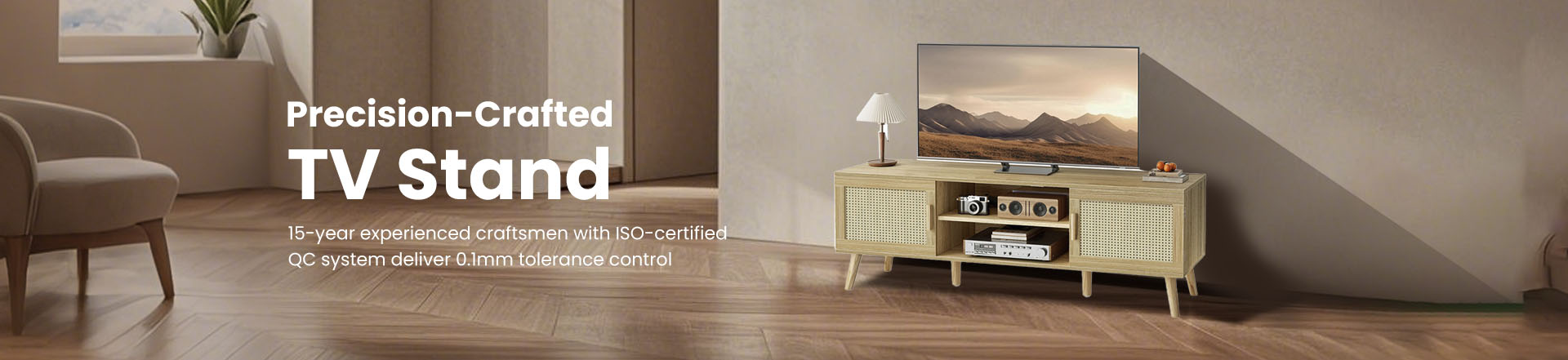
Our modern TV stand with storage illustrates how MDF and particle board can be combined within one furniture design. Different materials can be assigned to the parts where their processing and structural characteristics are most useful.
What About Screws and Repeated Assembly?
Both boards can be damaged when screws are repeatedly removed and reinserted without care. Furniture connectors should be selected for the panel core and expected assembly process.
Cam fittings, dowels, threaded inserts, confirmat-style fasteners, and metal brackets distribute forces differently. Accurate pilot holes help connectors align correctly, while suitable edge distance reduces splitting or breakout.
For products that may be disassembled frequently, the manufacturer should consider reusable connector systems rather than relying on screws driven directly into the same board hole each time.
Moisture Is a Critical Durability Factor
Standard MDF and particle board are not intended for continuous wet exposure. Water can enter through unfinished edges, scratches, drilling points, joints, or poorly sealed sink cutouts.
To extend service life:
Wipe spills promptly
Avoid placing panels directly on wet floors
Protect exposed edges and openings
Use coasters or mats where condensation is expected
Do not clean panels with excessive water
Maintain normal indoor ventilation
Select application-appropriate moisture-resistant grades when required
A surface coating can slow moisture entry, but it does not make every panel waterproof. Buyers should request clear material specifications instead of relying on general claims such as “waterproof wood.”
When Should You Choose MDF?
MDF is often the better choice when the design requires a smooth painted finish, shaped edges, detailed machining, or consistent decorative surfaces. It may also be useful for door and drawer fronts where surface appearance is a major purchasing factor.
The extra weight and material cost should be included in the structural, packaging, and freight assessment.
When Is Particle Board the Practical Choice?
Particle board is frequently suitable for straight panel construction, price-sensitive furniture, laminated cabinet bodies, shelves with controlled spans, and high-volume flat-pack programs.
A well-designed PB product can be durable in dry indoor use. Appropriate density, panel thickness, edge banding, connectors, and reinforcement are more informative than price alone.
Factory Material Selection for Different Components
As an MDF and particle board furniture OEM/ODM manufacturer, we can review drawings and use conditions before recommending a panel arrangement. Our product scope includes TV stands, Computer Desks, Gaming Tables, storage cabinets, bookcases, nightstands, wardrobes, and other home furniture.
We evaluate panel dimensions, metal support structures, hardware locations, edge treatment, surface finish, assembly sequence, and packaging together. Incoming-material checks and production inspections help control visible defects and dimensional variation, while trial assembly verifies actual fit.
Verdict: Which Is More Durable?
MDF may provide better surface uniformity and detailed machinability, while particle board often provides an efficient material for straight, laminated furniture panels. Neither wins every durability comparison.
For doors and decorative fronts, MDF may be preferred. For cabinet bodies and economical flat-pack construction, correctly specified PB may be entirely appropriate. In many cases, the strongest commercial solution is a hybrid design that places each material where it performs best.